You've spent months writing your book. The final chapter is finished, the title feels right, and you're ready to share your work. But one question keeps coming up: How do you actually turn your manuscript into a book people can buy?
Learning how to self publish a book is easier when you know what to do first. You don't need a literary agent or a traditional publishing deal. With the right preparation, you can publish your own book, choose its selling price, and reach readers across the United States.
Here's a practical guide to getting started without wasting money or missing important steps.
1. Prepare Your Manuscript Before Publishing
Finishing your first draft is exciting, but that doesn't mean your book is ready for sale.
Read through your manuscript carefully. Look for unclear sentences, repeated information, weak chapters, and anything that might confuse readers.
If you're writing a novel, check whether the characters and events make sense from beginning to end. For nonfiction, make sure each chapter answers a useful question.
Before moving forward:
Organize your chapters in the correct order.
Check spelling, grammar, and punctuation.
Ask a trusted reader for constructive feedback.
Review your opening pages for clarity and interest.
Save a separate copy of your final manuscript.
Many first-time authors rush this stage because they're excited to publish. Taking a little more time here can prevent expensive corrections later.
2. Edit and Format Your Book for Readers
Have you ever opened a book and noticed uneven spacing, strange fonts, or paragraphs that were difficult to follow?
Poor formatting can make even a good story frustrating to read.
Editing and formatting solve different problems. Editing improves the writing, while formatting controls how the words appear on each page.
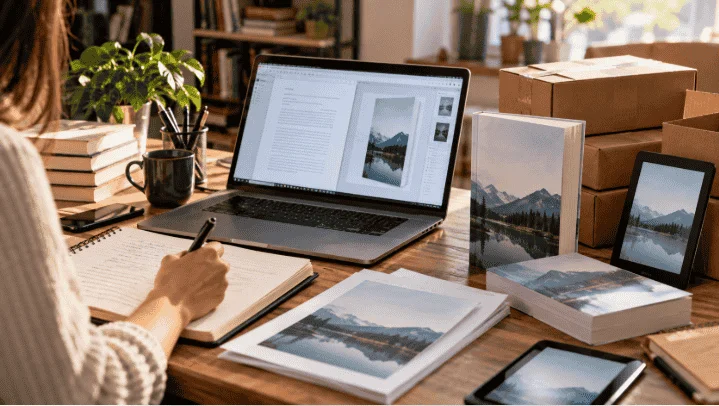
For a printed book, you'll need to consider page size, margins, chapter headings, and page numbers. A common trim size for novels is 6 × 9 inches, although the right size depends on your genre.
Ebooks need a different approach. Their text should adjust to different screen sizes, so a reflowable EPUB file is often suitable.
You can use writing and formatting tools yourself or hire professionals to prepare publication-ready files.
3. Create Your Own Book Cover That Fits Your Genre
Your cover may be the first thing someone notices while browsing an online bookstore.
Imagine searching for a mystery novel. One cover has a clear title, suitable imagery, and readable lettering. Another uses five different fonts and pictures that don't match the story.
Which would you investigate first?
When you create your own book cover, think about what readers expect from your genre.
A romance novel might use warm colors or character-focused artwork. A business book may work better with simple typography and a clean layout.
Make sure your design:
Looks clear even as a small online thumbnail.
Displays the book title and author name correctly.
Uses images and fonts you have permission to use.
Meets your chosen publishing platform's technical requirements.
For paperback and hardcover editions, you'll also need a complete cover file that includes the spine and back cover.
“”
4. Choose the Right Self Publishing Platform
Once your files are ready, you need somewhere to publish them.
Two well-known options for American authors are Amazon Kindle Direct Publishing (KDP) and IngramSpark.
Amazon KDP allows authors to publish ebooks, paperbacks, and hardcovers. IngramSpark offers print publishing and distribution services that can help make books available to bookstores, libraries, and online retailers.
You don't necessarily have to choose only one. Some authors use KDP for Amazon sales and IngramSpark for wider print distribution.
However, check ISBN rules, distribution settings, and any exclusivity agreements before publishing through multiple services.
For smaller projects, such as family histories, event guides, or self publishing booklets, you might prefer a short print run rather than making the book available for public sale.
The best platform depends on where you want readers to find your work.
5. Understand ISBNs, Publishing Costs, and Royalties
One of the most common questions beginners ask is, "How much does self publishing cost?"
There isn't one fixed price.
You might spend very little if you handle editing, design, and formatting yourself. Hiring professional editors and designers will increase your budget.
Typical expenses include manuscript editing, cover design, interior formatting, ISBN registration, printed proof copies, and marketing.
In the United States, Bowker is the official ISBN agency. Printed editions generally need their own ISBNs, while Amazon KDP doesn't require an ISBN for Kindle ebooks.
Some platforms provide free ISBNs, but these can limit your publishing imprint choices.
Royalties also deserve attention. Your earnings depend on the selling price, printing costs, sales channel, and platform terms.
Before choosing a $14.99 paperback price, for example, calculate what you'll actually receive after printing and distribution deductions.
6. Upload Your Book and Check Every Detail
Now comes the exciting part: preparing your book for publication.
Most self publishing platforms ask for your manuscript, cover, book description, author details, categories, keywords, and selling price.
Don't treat these as minor tasks.
Your book description helps readers decide whether your title matches their interests. Categories and relevant keywords also help retailers understand where your book belongs.
Before approving publication, inspect the digital preview carefully.
Check for missing pages, awkward chapter breaks, images that extend beyond the margins, and text that appears too close to the page edges.
For printed editions, ordering a physical proof is a sensible investment. Colors and spacing can look different on paper than they do on a computer screen.
7. Promote Your Self Published Book After Launch
Publishing your book doesn't guarantee that readers will discover it.
Start by identifying the people most likely to enjoy your work.
A children's activity book, for example, may appeal to parents, teachers, and homeschooling families. A local history book could interest community groups and independent bookstores.
You can introduce your book through:
An author website with a clear book description.
Social media posts sharing useful details or short excerpts.
An email list for interested readers.
Local libraries, bookstores, and community events.
Paid advertising, once you understand your audience and budget.
Don't feel pressured to promote everywhere at once. Choose one or two channels you can manage consistently.
And remember, marketing isn't limited to launch week. Reviews, reader recommendations, and ongoing promotion can help your book find new audiences over time.
Final Thoughts
Learning how to self publish a book doesn't mean you have to manage everything perfectly from the beginning. It means understanding each stage and making informed decisions about your work.
Start with a strong manuscript, prepare professional-looking files, choose a suitable publishing platform, and plan how readers will discover your book.
Self publishing gives you the freedom to create your own book on your terms. The real achievement isn't simply seeing your name on a cover. It's producing something readers can enjoy, trust, and recommend.