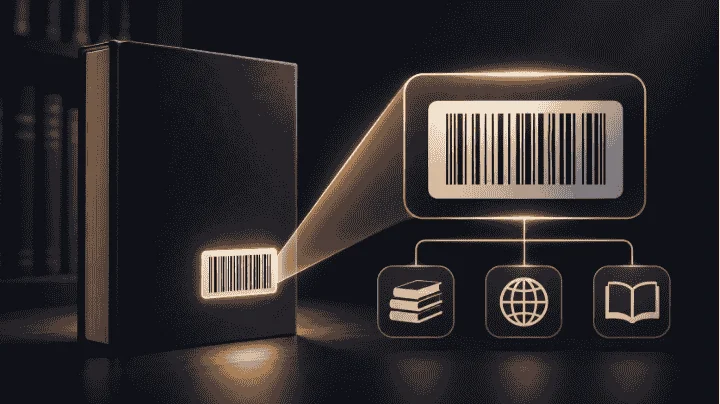
An International Standard Book Number (ISBN) is a unique identifier for a specific book edition and format. It helps bookstores, libraries, retailers, and distributors identify the correct publication. It does not establish copyright ownership, prove that a book has been edited, or guarantee distribution.
If you're preparing to self-publish, choosing an ISBN may affect your book's publisher listing and where you can distribute it. The decision is worth making before you finalize the interior file, copyright page, and cover. This guide explains what ISBNs do, how to find or buy one, when you need separate numbers, and how free ISBNs compare with independently registered ones.
What Is an ISBN, and What Does It Do?
ISBN stands for International Standard Book Number. ISBNs issued since January 1, 2007, contain 13 digits, usually beginning with 978 or 979. Older books may display a 10-digit ISBN. Both types may appear in library records and book searches.
A modern ISBN has five elements: a prefix, registration group, registrant, publication element, and check digit. Together, they help distinguish one published product from another in the book supply chain.
For example, a paperback and a hardcover can contain exactly the same story but still require different ISBNs. A store ordering the hardcover needs an identifier that points to that product, not the paperback. An ISBN also helps keep publisher, format, and edition information consistent across ordering systems.
An ISBN is not:
A copyright registration or proof of intellectual property ownership.
A guarantee that retailers or libraries will stock your book.
A quality rating, editing certificate, or endorsement.
A substitute for accurate title, author, format, and publisher metadata.
Do You Need a Different ISBN for Every Book Format?
Usually, each separately published format or edition that requires an ISBN needs its own number. Different language editions, substantially revised editions, and distinct digital products may also need separate identifiers. However, not every retail platform requires an ISBN for every format.
| Book version | ISBN guidance |
|---|---|
Paperback | Normally needs its own ISBN for retail distribution. Amazon KDP has an exception for qualifying low-content books. |
Hardcover | Normally needs a different ISBN from the paperback. KDP's low-content exception also applies to eligible hardcovers. |
Kindle ebook on Amazon KDP | An ISBN is not required. Amazon uses its own catalogue identifier, the ASIN. |
EPUB ebook distributed through other channels | ISBN requirements depend on the retailer or distributor. Under the ISBN standard, separately available digital products should be identified appropriately. |
PDF ebook sold as a distinct digital edition | May need its own ISBN when treated as a separate retail product, subject to the distributor's rules. |
Audiobook | A separately distributed audiobook is a different product form; check the channel's identifier requirements and assign a distinct ISBN where applicable. |
Example: Suppose you release a novel as a paperback, hardcover, and separately distributed EPUB edition. If all three editions use ISBNs, they should not share one number. You would normally assign three distinct ISBNs. A Kindle edition published only through KDP does not require an additional ISBN.
When Do You Need a New ISBN for an Existing Book?
A new ISBN is generally appropriate when you publish a different format, translate the book into another language, make substantial content revisions, change the title, or publish under a different publisher. By contrast, correcting a few typos, adjusting the price, or making an ordinary promotional cover change usually does not require a new ISBN.
If you're uncertain whether a revision counts as a new edition, check the rules of the ISBN agency serving your country before assigning another number. Once an ISBN has identified a published book, you cannot recycle it for a different title.
“”
Free ISBN vs. Paid ISBN: Which Should You Choose?
Some publishing platforms offer free ISBNs, while independent publishers can obtain their own through the official ISBN agency for their country. Neither option automatically makes a book better or more professional. The important differences are where the number can be used and which publisher or imprint appears in the book's records.
| Option | Where it can be used | Publisher/imprint listing | Best suited for |
|---|---|---|---|
Free KDP ISBN | KDP only | “Independently published” | Eligible print books staying on KDP |
Free IngramSpark ISBN | IngramSpark only; offered to eligible U.S. publishers | “Indy Pub” | Eligible U.S. publishers using IngramSpark's distribution |
Independently registered ISBN | The same eligible edition can generally use it across compatible platforms | Your correctly registered publisher/imprint | Authors planning multiple distribution channels or their own imprint |
When a Free KDP ISBN Makes Sense
Amazon Kindle Direct Publishing (KDP) provides free ISBNs for eligible paperback and hardcover books. The number is registered with the imprint “Independently published” and cannot be used to publish the edition on another platform. KDP does not require an ISBN for Kindle ebooks.
Low-content books, such as certain notebooks, planners, and journals, may be published on KDP without an ISBN, but they are not eligible for KDP's free ISBN. If you choose to use an ISBN for a low-content book, you must provide your own.
For an author whose print edition will remain on KDP and who does not need a custom imprint in the book record, the free ISBN can be an economical choice.
What About IngramSpark's Free ISBN?
IngramSpark also offers free ISBNs to eligible U.S.-based publishers during title setup. These numbers are associated with the imprint “Indy Pub” and are restricted to IngramSpark. They cannot be transferred to another publishing platform or account.
If you later want to distribute the same edition elsewhere using your own publisher identity, you may have to create a new listing with a newly obtained ISBN. Check the platform's current terms before relying on a free identifier as part of a long-term distribution plan.
Why Buy Your Own ISBN?
An independently registered ISBN offers greater flexibility when you want to list your publishing imprint and use the same edition across compatible printing and distribution services. It can be particularly useful for authors building a publishing business or distributing through both KDP and IngramSpark.
Purchasing an ISBN does not buy the copyright to the manuscript. It also does not guarantee bookstore placement, sales, or acceptance by a distributor. Its value is accurate, portable product identification within the rules of participating platforms.
How to Buy an ISBN for Your Book: 5 Steps
If you decide to obtain an independently registered ISBN, follow this process before finalizing production files.
Find your official ISBN agency. Apply through the national or regional agency serving the country where your publishing operation is based. In the United States, the official agency is Bowker. Publishers in other countries should check their designated agency rather than assuming a U.S. purchase is appropriate.
Plan your formats and editions. List the paperback, hardcover, separately distributed ebook editions, audiobook, and any translated or substantially revised editions. Determine which need ISBNs under the applicable standard and platform rules.
Register your publisher or imprint details. Use the correct publishing name. If you're self-publishing, you may be the publisher of record. Avoid buying an identifier from an unrelated party that would incorrectly identify them as your publisher.
Obtain the ISBNs and register the book information. Follow your agency's process, including any applicable payment, and enter the correct title, author, format, and publication details. Fees vary by country and can change.
Match the ISBN to your final files and distribution account. Check that the ISBN and imprint information in the agency record match the information you submit to KDP, IngramSpark, or another service. Then confirm that the copyright page and cover barcode, if present, refer to the correct edition.
Planning tip: If you expect to publish multiple formats or future books, compare the agency's available ISBN quantities before purchasing. Do not buy extra numbers solely because a reseller claims that owning more ISBNs will improve rankings or sales.
“”
How to Get a Free ISBN on Amazon KDP
For an eligible paperback or hardcover, you can obtain a free ISBN during the KDP setup process:
Open your KDP Bookshelf and select the print edition you are preparing.
Open the paperback or hardcover content section.
Find the ISBN section and choose Get free KDP ISBN.
Select Assign ISBN and review your book details.
Continue preparing your interior and cover files using the assigned number.
If you already have an independently registered ISBN, use KDP's Add your own ISBN option instead and enter the matching imprint details. Once your title is published, changing ISBN arrangements may require creating a new edition or listing, so decide before release.
How to Find a Book by ISBN: ISBN Number Lookup
An ISBN lookup helps you find or verify the publication associated with a number. Modern books generally display 13 digits; older books may display a 10-digit ISBN. Look for the number on the copyright page, back cover, publisher website, or retailer listing.
To check an ISBN:
Copy the exact number. Include all digits. Hyphens or spaces often separate groups for readability, but the digits are what matter.
Search a reliable catalogue. Try a bookseller, library catalogue, or the relevant ISBN agency's publisher records, where available.
Compare more than the title. Verify the author, publisher or imprint, language, publication details, and format. A paperback and a hardcover may have similar titles but different ISBNs.
Check the publisher's own records. If it's your book, compare the agency's registered data with the distribution dashboard and the printed copyright page or barcode.
Investigate mismatches before publishing. If your files and platform metadata show different ISBNs, correct the discrepancy before approving the proof.
A newly assigned ISBN may not appear immediately in every retailer or library search. An empty search result does not, by itself, prove that the number is invalid. Registration data and retailer catalogue updates do not always happen at the same time.
ISBN vs. Barcode vs. ASIN vs. Copyright
These four terms solve different problems:
| Term | What it means |
|---|---|
ISBN | A standardized identifier for a particular publication, edition, and format. |
Barcode | A machine-readable graphic printed on a physical book, often encoding its ISBN. |
ASIN | Amazon's own catalogue identifier; it is not interchangeable with an ISBN. |
Copyright | Legal protection for an original work under applicable law; purchasing an ISBN does not create or register it. |
You may not need to buy a separate barcode. If you upload a print-ready cover to KDP without one, KDP can add a compliant barcode to the back cover at no additional charge. If you supply your own, it must match the ISBN and meet the platform's formatting and placement requirements.
For a print book, confirm the edition's ISBN before designing the final full-wrap cover. Leave the required barcode area clear, and inspect the printed proof to make sure the barcode is readable and the copyright-page details match the publishing dashboard.
Real-World Example: Publishing a First Novel
Imagine you're publishing a 6-by-9-inch paperback through KDP, then plan to release a hardcover and make the paperback available through IngramSpark.
A free KDP ISBN may work for the original paperback if you're comfortable keeping that ISBN on KDP. But you cannot reuse that free KDP ISBN on IngramSpark. If you intend to distribute the same paperback edition through multiple compatible services under your own publisher identity, securing your own ISBN before launch will usually make coordination easier.
The hardcover is a separate product and needs its own ISBN when required by the platform. A separately distributed ebook may also need its own identifier, depending on the format and channel. The Kindle edition on KDP does not require an ISBN.
Before you pay for formatting and cover design, write down each edition's format, ISBN source, imprint, and distribution service. That small planning exercise can prevent mismatched metadata and costly cover-file revisions.
“”
Common ISBN Mistakes That Delay Publication
Reusing an ISBN across formats. A paperback ISBN should not also identify the hardcover.
Assuming a platform's free ISBN works everywhere. KDP and IngramSpark free ISBNs have platform-specific restrictions.
Registering the wrong publisher. The imprint in the ISBN record should accurately identify the publisher of record.
Submitting inconsistent metadata. Differences between the registered title, imprint, edition, and publishing dashboard can block or delay setup.
Paying for an unnecessary barcode. Check whether the printer can generate one before buying a separate image.
Buying ISBNs to 'improve SEO.' An ISBN helps identify a product; it does not automatically improve online search rankings.
Using a new ISBN for every small edit. Routine typo corrections, price changes, and minor promotional cover updates generally do not require a replacement number.
Your ISBN Checklist Before Publishing
Before uploading your final files, confirm that you have:
Choose the formats and distribution channels you plan to use.
Identified which formats need separate ISBNs.
Select a free or independently registered identifier based on your imprint and distribution goals.
Checked the registered title, author, edition, and publisher details.
Matched the ISBN in your metadata, interior, and barcode where applicable.
Reviewed the printer's cover and barcode requirements.
Inspected a proof copy of each print format.
An ISBN is a small piece of the publishing process, but choosing the right one early helps keep your records, files, and distribution plans consistent. Getting those details right is much easier before the book goes live than after readers and retailers begin ordering it.